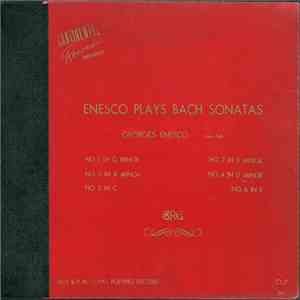
» » Enesco - Plays Bach Sonatas

Enesco - Plays Bach Sonatas download free

Genre: Classical
Performer: Enesco
Title: Plays Bach Sonatas
Style: Baroque
Date of release: 1950
Country: US
MP3 album size: 1994 mb
FLAC APE album size: 1181 mb
WMA album size: 1439 mb
Digital formats: MOD RA AAC MIDI VOX MP3 VOC
Enesco - Plays Bach Sonatas download free

Tracklist

Sonata No. 1 In G Minor
Adagio
Fuga
Siciliano
Presto
Sonata No. 2 In A Minor
Grave
Fuga
Andante
Allegro
Sonata No. 3 In C Major
Adagio
Fuga
Largo
Allegro Assai
Partita No. 1 In B Minor
Allemande
Double - Corrente - Double
Sarabande
Double
Bourre
Double
Partita No. 2 In D Minor
Allemande
Courrante
Sarabande
Gigue
Chaconne
Partita No. 3 In E Major
Preludie
Loure
Gavotte En Rondeau
Menuet No. 1 - Menuet No. 2
Bourre
Gigue

Versions

Category Artist Title (Format) Label Category Country Year
CLP-104/106 Enesco* Plays Bach Sonatas ‎(3xLP, Mono, Promo + Box) Continental CLP-104/106 US 1950
CLP 104/6 Enesco* Plays Bach Sonatas ‎(3xLP, Mono + Box) Continental CLP 104/6 US 1950
CLP 104/105/106 Enesco* Plays Bach Sonatas ‎(3xLP, Mono + Box, Unofficial) Continental CLP 104/105/106 US 1950
8117/3 Bach* - Georges Enesco* Bach* - Georges Enesco* - The Bach Complete Sonatas And Partitas For Violin ‎(3xLP, RE + Box) Olympic Records 8117/3 US 1974
CDO 2014 J. S. Bach* / George Enescu J. S. Bach* / George Enescu - Sonatas And Partitas For Solo Violin ‎(2xCD, RE + Box) Pickwick CDO 2014 US 2004
013 Bach*, George Enescu Bach*, George Enescu - Enescu Plays Bach: Sonatas And Partitas ‎(2xCD, RE, RM) Magazinul Muzica 2001, Institutul Cultural Român 013 Romania Unknown
Discussion about Enesco - Plays Bach Sonatas
Thetahuginn
"The September 1950 edition of Schwann Long Playing Record Catalog lists two complete sets. One set is by violinist Alexander Schneider on Mercury MGL-1 (4x 12" LP discs, individually numbered MG 10017/10018/10019/10020) recorded in 1949 by C. Robert Fine (engineer) and Mitchell Miller (recording director) at Reeves Sound Studios, New York City. The other available set was the one performed by Georges Enescu on Don Gabor's Continental Records label with references CLP 104-105-106, also recorded in 1949. Obviously these recordings were made for release in 1950, the 200th anniversary of Johann Sebastian Bach's death.Images of the original box and the label of the third record courtesy Chuck Miller, writer and columnist ("Goldmine" and "Warman's American Records 1950-2000").In Billboard Magazine of August 26, 1950, the Continental CLP-104 release (the first record of the set with Sonatas Nos. 1 and 2) was reviewed: "With the load of competition on LP of this limited-sale material, these Enesco cuttings may have tough pulling to get representation outside the few big longhair tenters. Many connoisseurs will prefer them, however, for their rugged, warm and human quality. The noted virtuoso and teacher may not be the last word in technique, but he can offer most fidlers a lesson in broad style. In certain bright passages he manages to infuse an almost gypsy like fervor. Pressing and surfaces are very good."The reviewer refers to Bach's Sonatas and Partitas as "limited sale material". In the 78 RPM shellac era the popularity of these works was even less prominent than at the time of the evaluation by the reviewer in Billboard Magazine in the "Bach Year".In the shellac era there were recordings of individual Sonatas by Joseph Szigeti (Sonatas Nos. 1 and 2), Nathan Milstein (Partita No. 2), and Adolf Busch (Partita No. 2). The only set which could be considered as "most complete" was the one of George Enesco's pupil Yehudi Menuhin. He played Sonata No.1, Partita No. 1, Sonata No. 2 - 3rd movement only, Partita No. 2, Sonata No. 3, Partita Nr. 3. These data are given in The Gramophone Shop Encyclopedia of Recorded Music, 1948.Irving Kolodin evaluated the Menuhin recordings in The New Guide To Recorded Music (Doubleday, New York, 1950). The recordings were made over a period of several years and varied in quality of performance and in sound recording technique. Various dates are given in various publications. For the earliest recording 1931 is given, but generally discographers mention 1934 as the year of the first recording. The last year he recorded on 78 RPM was 1944. Some of his playing was considered to be "outstanding and even unchallengeable" at the time.Enesco's complete 3 LP set was also made available in Romania by Don Gabor. The records were pressed in the US but had a different design for the label. No reference numbers were printed on the label. The plates were numbered TA-016 to TA-021 in the dead wax. The name CONTINENTAL was not printed on the label. They were stored in a simple, plain box. The only printed part of it were the liner notes, the same as in the US edition.The Enesco Continental performances however were recorded on acetates. An acetate is an aluminum disc of 10, 12 or 16 inches in diameter, coated with a layer of wax or lacquer in which the signal is engraved. (Because of the scarcity of aluminum during World War II the aluminum was often replaced by glass.) Enesco's performances were recorded in 1949. From these acetates the signal was transferred to the actual lacquer on the cutting lathe from which the matrices and plates were made to press the LPs from.The acetates initially served as the source for the Continental 3 LP set and were only later transferred to tape. On the back of the reissue on the Olympic 3 LP set from 1974, it is mentioned that the acetates were transferred to tape by the Everest engineers and were edited and filtered in order to eliminate pops and hiss. That could have been the best option while transfers to tape by the Gabor people may also have shown the technique of tape recording in the early 1950s.Enesco's Continental Set was still available in January 1952, but was deleted from the Schwann catalog by March of that year. A reason to discontinue the set could have been that sales were not very high since the technically better sound recording done by Mercury of Alexander Schneider's playing was obviously preferred by many, despite the fact that the three Continental records were cheaper than the four Mercuries (though at the time a single Continental record had the same price tag as a Mercury LP).Another reason could have been the criticism on the technical aspects of Enesco's playing from a few reviewers who adhere a greater significance to the technique of the artist than to the musicality, the intrinsic value of the performance. When reviewing Sonata No. 2, the only Sonata which was released on the Remington label in the early 1950s, Cecil Smith wrote in New Republic in April of 1951: "George Enesco's playing of Bach's E minor Sonata for unaccompanied violin offers, like Enesco's appearences in public, painful proof that even a fine musician cannot play an instrument effectively without adequate technique."Smith obviously forgot that this is Enesco at 67, suffering from arthritis, and that his ability was only a shadow of his powers when he was a young man. However there is more greatness in these performances shining through than is technically performed and is recorded in the groove. From March 1952 on only Enesco's playing of Sonata No. 2 on the 10 inch Remington (PL1-149) remained in the catalog, probably to please a few admirers and maybe to please Enesco as well. From then on the Mercury set with Alexander Schneider (MG 1017/18/19/20) was the only complete issue available at that moment."
Enesco - Plays Bach Sonatas related music albums